Government Data Exchange: From Point-to-Point Integrations to a Governed Ecosystem
A digital public service rarely exists within a single information system. Granting a benefit, registering a business, or confirming a person's eligibility may require data from several registers. Service quality therefore depends not only on a convenient interface, but also on how reliably public authorities exchange data.
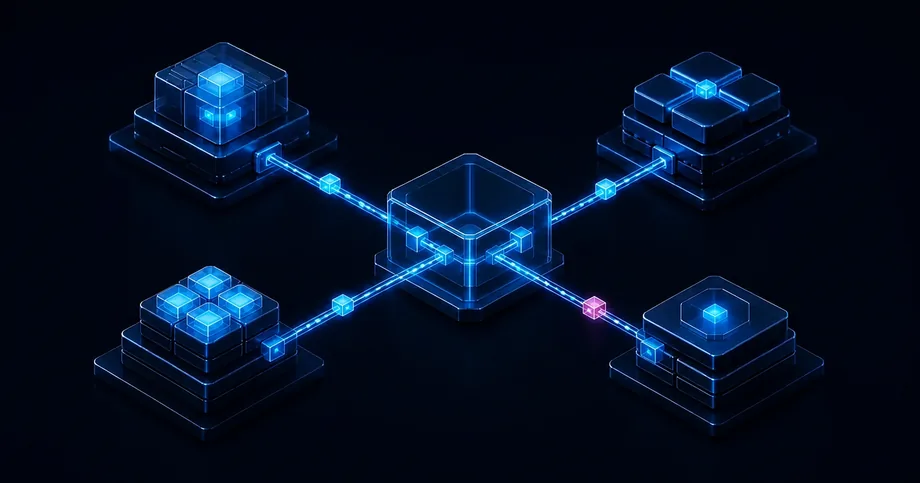
Modern interoperability does not mean moving every record into one central database. Its purpose is to give systems shared exchange rules while preserving each authority's responsibility for its data. The source register remains the authoritative record, and the consuming system receives only the answer required for a specific service.
Shared rules, not a single database
Point-to-point integrations work while the number of participants is small. As the network grows, every change to a format, access rule, or service version can affect many systems at once. Unsynchronised copies, manual reconciliation, and connections with unclear ownership begin to accumulate.
A federated model addresses a different problem: it makes a distributed ecosystem governable instead of merging everything into a monolith. For each data set, the parties define an owner, a legal basis for use, a service contract, access rules, and a service level. The exchange layer routes requests and responses, but it does not replace the registers or blur responsibility for data quality.
Trembita as exchange infrastructure
Ukraine's Law on Public Electronic Registers establishes the legal and organisational foundations for creating, maintaining, administering, using, and connecting public electronic registers. For architects, this is an important constraint: technical exchange must be grounded in clear authority, roles, and rules for handling data.
At the practical level, the Trembita system supports protected interaction between state electronic information resources. It should be understood not as a “super-register”, but as infrastructure through which participants publish and consume agreed electronic services. Data remains in the responsible systems, while requests follow defined rules.
In July 2025, Ukraine's Ministry of Digital Transformation announced the Trembita 2.0 pilot. This illustrates how exchange infrastructure evolves alongside scaling and security requirements. Any implementation should still check the current regulations, available mechanisms, and production status of the components it intends to use.
Six principles of mature interoperability
- Data ownership and an authoritative source. For every attribute, teams need to know which system is responsible for its accuracy, who corrects errors, and how consumers are notified of changes.
- Once-only and data minimisation. People and businesses should not be asked again for information that the state is already legally entitled to retrieve from an authoritative source. At the same time, a service should return only the necessary minimum, not a full registry record “just in case”.
- A service contract. Request and response structures, field semantics, error codes, time limits, and compatibility rules must be documented. Versioning allows a service to evolve without unexpectedly disrupting its consumers.
- Verified identity and least privilege. Access is granted to a particular system for a particular purpose. Qualified electronic signatures, PKI, and related controls are used where authentication, integrity, or legal significance requires them, but they do not replace a sound authorisation model.
- Traceability without excessive collection. Correlation identifiers, technical logs, and decision records make it possible to reconstruct a transaction. Logs also need access control, retention rules, and protection against unnecessary personal data being recorded.
- Resilience to failure. Timeouts, retries, idempotency, and duplicate control must be part of the contract from the start. Asynchronous exchange is appropriate for long-running or bulk operations, so a temporary outage at one participant does not stop the whole process.
Security and observability are system properties
Zero Trust, SIEM, cloud infrastructure, and containerisation are useful only within a coherent model of threats and responsibilities. Zero Trust begins with verifying every connection, granting minimal rights, and limiting credential lifetimes. SIEM is valuable when events are structured, connected to transactions, and useful for investigation rather than merely accumulated.
Operations teams need observability: where a delay occurred, which service returns errors, how load changes, and whether exchanges meet the agreed service level. Metrics, traces, and logs should share a request identifier. This makes it possible to localise an issue across several institutions without manually inspecting dozens of systems.
Continuity must also be designed in advance. Degraded operating modes, queues, backup channels, disaster recovery, and message reprocessing procedures should be tested before production launch. High availability of one server does not guarantee availability of the public service when a dependent register or network route is unavailable.
A practical implementation route
- 1. Inventory exchanges. Describe which data the process requires, where it originates, who uses it, and the legal basis for that use.
- 2. Agree responsibilities. Identify data owners, error-correction rules, update expectations, and contact roles for incidents.
- 3. Design the contract. Define the data model, minimal response, authorisation, error codes, versioning, idempotency, and service level.
- 4. Run a pilot. Test the integration in a non-production environment with test or appropriately anonymised data, including negative and failure scenarios.
- 5. Establish control. Add metrics, tracing, audit logs, alerts, and operational procedures before go-live.
- 6. Scale deliberately. Connect new consumers through a catalogue and reusable contracts while controlling compatibility, load, and retirement dates for older versions.
IQusion's role in interoperability projects
IQusion helps institutions move from a collection of individual connections to a governed architecture. The work may include auditing existing exchanges, data modelling, integration design, developing services and adapters, setting up observability, testing failure scenarios, and supporting a phased launch.
An integrator's value is not in creating another centre that owns government data. It lies in establishing shared rules that make autonomous systems compatible, secure, and predictable in operation. This model enables new digital services without multiplying data copies or turning every change into a separate integration project.