Integrating AI into Business Processes: How to Do It Right?
Artificial intelligence is moving from the realm of experiments into the realm of critical infrastructure. For businesses and government bodies, the question is no longer whether to use AI, but how to integrate it into existing IT landscapes without violating security requirements, regulatory demands, and process continuity.
Today, IT department heads face a paradox: on one hand, there is a powerful tool for increasing efficiency; on the other, there are risks that could cost reputation, contracts, or even legal compliance. This is precisely why AI is ceasing to be an "innovation module" and becoming part of an organisation's architectural framework.
A distinctive feature of the public and corporate sectors is legal liability for errors. The difference between a public chat service and a managed AI architecture is the same as between a test server and a certified state information system: in the first case, it's about convenience and speed; in the second, it's about responsibility, control, and regulation.
A Typical Customer Error
The most common scenario seems simple: connect a large model's API directly to an EDMS or CRM, test a few scenarios – and gradually expand its use.
Initially, everything works. After some time, questions arise:
- where exactly are requests stored,
- are responses logged,
- how to prove GDPR compliance,
- what happens if the model version changes,
- who is responsible for an incorrect result.
AI begins to live a life of its own – outside the overall IT architecture.
At IQusion IT LLC, we view AI not as a separate service, but as an intelligent layer within system integration. This means it adheres to the same principles as any critical IT component:
- Zero Trust Architecture
- Data Governance
- High Availability
- Auditability & Traceability
- Regulatory Compliance
Artificial intelligence does not operate "outside the system". It must function within a controlled digital framework.
Key Risks of Uncontrolled AI Integration
Most problems with AI implementation arise not from the technology itself, but from its uncontrolled use. Below are typical risk scenarios we encounter in system integration practice.
Risk of Data Loss of Control
Transferring data to external AI platforms means:
- storage or processing in a third-party infrastructure,
- potential data placement outside jurisdiction,
- difficulty in proving compliance with GDPR requirements or national data protection standards.
For the public sector, this can create a risk of violating requirements regarding:
- personal data processing,
- official information,
- restricted access information.
Without a clear Data Governance policy, artificial intelligence turns into a "black box", for which the customer still bears responsibility.
Uncontrolled Model Behaviour
LLM models are statistical by nature. They can:
- generate incorrect references,
- alter the wording of legally significant provisions,
- create non-existent regulatory acts.
In everyday use, this appears as a "minor error".
In government processes, it represents a potential legal risk that can have financial and reputational consequences.
Therefore, any AI framework must have mechanisms for verification, validation, and generation limitation.
Operational Dependence on the Provider
External API platforms can:
- change model versions,
- alter costs or limitations,
- temporarily cease operation.
If AI is integrated directly into the application processing workflow, this creates a single point of failure risk. Critical infrastructure cannot depend on a single external service without a fallback mechanism.
IQusion IT's Architectural Approach
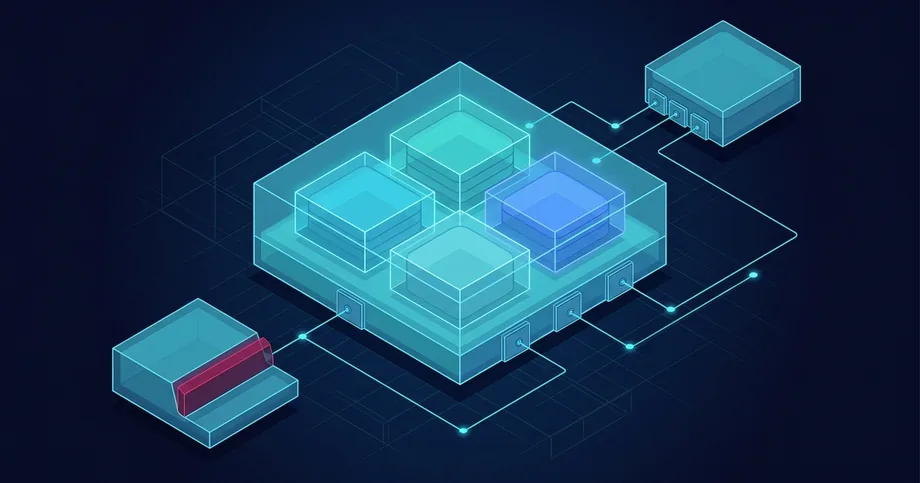
We apply a multi-layered AI integration model, where each layer has its own control function. This approach allows combining the flexibility of neural networks with the requirements of regulated environments.
AI as Part of the Service Bus
Integration Layer
AI is not integrated directly into EDMS or ERP. It connects via:
- Enterprise Service Bus (ESB)
- Middleware layer
- API Gateway with access policies
This ensures centralised management, access control, logging, rate-limiting policies, and traffic encryption. In other words, AI operates within the same service discipline as other corporate systems.
Data Processing Framework
Data Isolation Layer
Before transmission to the AI module, the following are applied:
- personal data masking,
- identifier tokenisation,
- information classification,
- Data Loss Prevention (DLP) policies.
AI receives only the minimally necessary context. This reduces regulatory risks and increases system controllability.
RAG Architecture
Retrieval-Augmented Generation
We implement:
- a local vector store,
- indexing of internal regulatory documents,
- control over response sources,
- limiting generation to only verified data.
This ensures the controllability of results and reduces the risk of hallucinations. The model receives a verified context, and the sources of the response can be traced.
Model Orchestration
Model Orchestration & Policy Engine
- orchestration of multiple models,
- result verification according to defined rules,
- compliance check against regulations,
- automatic blocking of responses upon policy deviation.
Thus, AI becomes a managed tool, not an autonomous decision generator.
Human at Control Points
Human-in-the-Loop
- AI results are not published automatically,
- approval by a responsible employee is provided,
- the request version, model, date, and context are recorded.
This retains human responsibility for the final decision and creates an audit trail.
Continuity and Redundancy
High Availability & Fallback
- provider redundancy,
- response caching,
- template fallback scenarios,
- automatic switching upon unavailability.
The AI framework should not halt business processes. If the intelligent module is unavailable, the system switches to a controlled operational mode.
Deployment Options
- Enterprise Cloud with Contractual SLA
- Private Isolated Instance
- On-Premise deployment in a certified environment
- Hybrid model with local processing of sensitive data
The deployment model is determined by the data criticality level, regulatory requirements, and the customer's information security policy.
Control and Audit
- logging in accordance with the retention policy,
- model version preservation,
- prompt version preservation,
- recording of context and responsible user,
- periodic accuracy audit.
This transforms AI from a "creative tool" into a managed component of the digital architecture.
For the Public Sector
The AI framework architecture must comply with:
- ISO/IEC 27001,
- national standards for technical information protection,
- access management policies,
- personal data storage requirements.