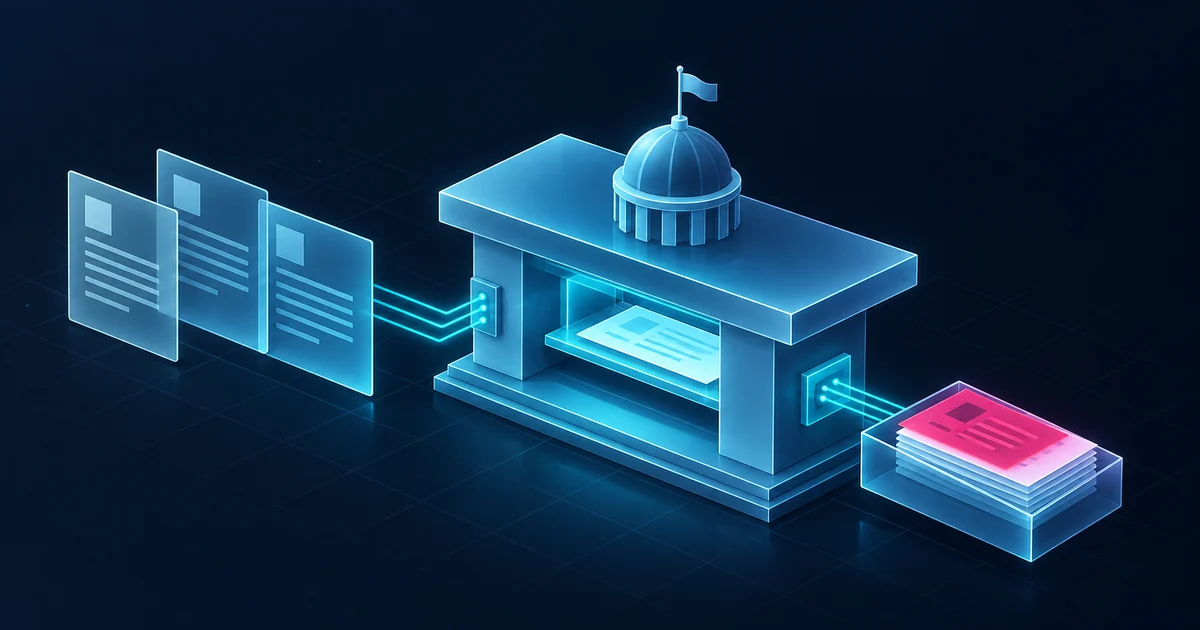
Electronic Document Management for Municipal Enterprises: Advantages of Megapolis.DocNet

A municipal enterprise works daily with incoming letters, contracts, citizens' appeals, regulatory documents, and management assignments. Electronic document management yields practical results only when these materials, approval workflows, deadlines, and responsible assignees are consolidated into a single managed loop.
This was discussed by Serhiy Balashuk, Director of LLC IQUSION IT, during a presentation for clients of the Intecracy Group association. The presentation focused not on simply replacing paper with files, but on end-to-end document processing — from registration to execution, search, and storage.
Not Digitising Paper, but Linking Responsibility
A scanned copy on its own does not make a process manageable. If a letter is registered in one system, the resolution is sent by email, the deadline is tracked in a spreadsheet, and the final response is stored in a department folder, the manager cannot see the complete history. Employees have to manually find out which version of the document is current, who approved the decision, and where execution has stalled.
Megapolis.DocNet links preparation, registration, routing, approval, QES signing, execution control, search, and archiving. The solution is connected with InBase and built on the UnityBase platform; IQusion designs the implementation, configures processes, and integrates the system into the customer's existing IT infrastructure.
For a municipal enterprise, this means that an incoming document can not only be registered but also immediately routed along a defined path, with an assignment created, an assignee designated, a deadline set, and the result saved in a single history. This approach reduces the process's dependence on the personal memory of employees and provides the manager with a verifiable picture of execution.
What Megapolis.DocNet Encompasses
The configuration depends on the regulations and systems of the specific enterprise: not every implementation requires all modules and integrations. It is advisable to form the basic loop around processes with a high volume of documents, multiple participants, and a need to control deadlines.
- Incoming and Outgoing Correspondence. Structured cards, metadata, and workflows help preserve the document along with the context of its processing.
- Appeals and Official Requests. Registration, transfer to the responsible department, assignments, and the outcome of the review remain within a single process.
- Contracts and Approvals. Sequential or parallel workflows enable the participation of the legal department, accounting, and specialized experts without exchanging numerous copies.
- Resolutions and Execution Discipline. Tasks, deadlines, notifications, and monitoring of department workloads show not just the fact of document registration, but also its execution status.
- Search and Information Reuse. Attribute-based search and ElasticSearch full-text search help find the required material and related documents; a separate OCR module can be applied for scanned packages.
- Mobile Work and Additional Modules. Depending on needs, mobile access, eCourt, OCR, and other components can be added to the loop.
Advantages for the Daily Operation of the Enterprise
| Area | Disjointed Work | Single EDMS Loop |
|---|---|---|
| Registration | Separate logs and files | Document card with metadata and history |
| Approval | Copies in email and messengers | Defined workflow and recorded decisions of participants |
| Assignments | Manual tracking of deadlines | Assignee, deadline, notifications, and status in a single process |
| Search | Dependence on file names and folder structure | Search by metadata, content, and related materials |
| Audit | Gathering evidence from various sources | Action log and document history trail |
This difference is particularly noticeable in processes where a single document passes through several departments. The system does not replace regulations but makes their execution visible: each participant works with their part of the process, and the manager sees the overall status without manual data consolidation.
QES, Access Rights, and Audit
Megapolis.DocNet supports QES from Ukrainian trust service providers and cloud signatures. This allows signing to be included in the electronic workflow rather than being handled as a separate process. Specific signature formats, cryptographic modules, and storage rules should be defined during the implementation design phase.
Access control is necessary so that an employee sees only those documents and operations that correspond to their role. An action audit preserves a verifiable history of work with the document and helps reconstruct the sequence of decisions during an internal review. An expert opinion with a G-2 assurance level is claimed for the product, but the security of a specific implementation also depends on the infrastructure, access configuration, administration, and operational procedures of the customer.
Integrations Without Re-entering Data
A municipal enterprise already has an accounting system, HR data, reference books, email services, or industry-specific applications. Therefore, an EDMS should not be designed as an isolated repository. The open API of Megapolis.DocNet allows connecting CRM, ERP, BPM, HR, and accounting systems, and defining where the master record is created and where it is merely used.
For exchange with external loops, integrations with SEV OVV, NBU Mail, Deals, Vchasno, and PTAKH are available. The required set of connections is determined based on the actual workflows of the enterprise: what documents it receives, to whom it sends them, where it applies QES, and what statuses must be returned to the internal card.
How to Start Implementation
The first candidate should not be the most prominent, but the best-described process with a measurable document flow and a clear owner. Before starting the implementation of electronic document management, the following conditions should be verified:
- Process Boundaries. Define which event starts it, what result concludes it, and what types of documents it encompasses.
- Roles. Record the registrar, approvers, assignees, controller, and process owner.
- Deadlines and Exceptions. Describe not only the standard workflow but also returns for revision, substitution, and overdue tasks.
- QES and Paper Originals. Determine where an electronic form is sufficient and where regulatory or contractual requirements dictate a different procedure.
- Integrations. List the systems, reference books, and external services with which the process exchanges data.
- Acceptance Criteria. Establish in advance the criteria by which the enterprise will verify the correctness of the workflow, access rights, search, and reporting.
Frequently Asked Questions
Is it necessary to implement all Megapolis.DocNet modules at once?
No. The composition of the initial loop is determined by the enterprise's regulations, priority processes, and required integrations. Additional components must be justified by a specific operational scenario.
What does QES within a document workflow provide?
QES allows signing to be included in the approval sequence and preserves the signed document along with its history trail. The exact configuration of verification and storage is determined for each specific implementation.
What is the role of IQusion in working with Megapolis.DocNet?
IQusion designs and implements the electronic document management loop, configures workflows and access rights, connects the required systems, and supports the solution. Megapolis.DocNet is connected with InBase and built on UnityBase.