Electronic document management in the agricultural sector: from field to market
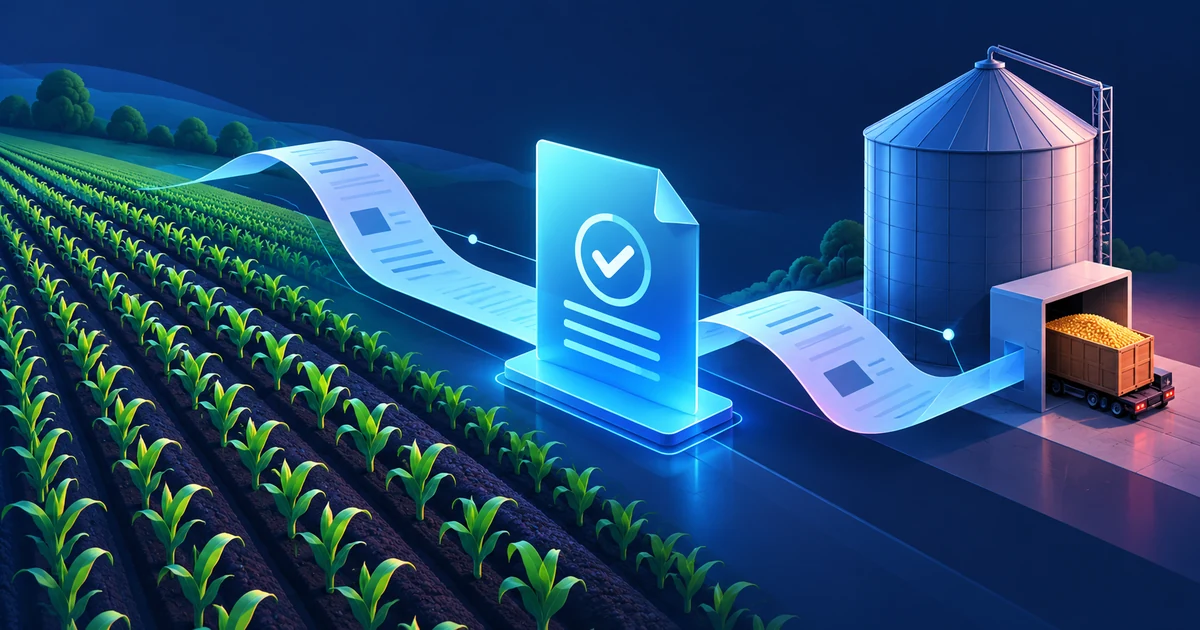
During the harvesting campaign, documents move between the field, weighbridge, grain elevator, and central office. A lost consignment note or unapproved specification complicates delivery reconciliation and delays settlements. During a presentation for clients of the Intecracy Group consortium, IQusion IT LLC Director Serhii Balashuk spoke about the digitalization of the agricultural sector. One of its practical tasks is to streamline this document chain. An electronic document management system helps link documents to a specific operation, identify those responsible for approval, and organize the search for the required set.
The document chain of an agricultural enterprise: from procurement to sales
The operational activity of an agricultural holding or farm is accompanied by a large volume of legal and financial papers. A typical document chain covers several consecutive stages:
- Creation and approval of internal purchase requisitions for plant protection products, fuel and lubricants, seeds, and spare parts.
- Concluding contracts with suppliers and supplementary agreements. For electronic signing, the authority of the parties and the applicable signature type are determined; legal conditions are established by the Law of Ukraine "On Electronic Identification and Electronic Trust Services".
- Drawing up primary completion certificates, acceptance-transfer certificates, and consignment notes during field operations and transportation.
- Storage and approval of quality documents and laboratory analyses received from responsible specialists and specialized laboratories.
- Forming final sets of sales documents for shipping products to buyers, elevators, or export terminals.
An electronic document management system (EDMS) does not independently generate laboratory analyses or certificates, but it ensures their storage, systematization, and rapid access by responsible employees to properly signed originals.
Hypothetical harvest shipment scenario and data reconciliation
Let us consider a hypothetical example of shipping wheat grain from a field threshing floor to an elevator. In this scenario, the responsible dispatcher or storekeeper creates a transportation request and attaches the necessary primary documents to it. An authorized laboratory specialist measures moisture, foreign matter, and protein parameters, after which they upload the completed electronic analysis report into the EDMS.
To link with the accounting system, a common product batch identifier can be agreed upon. Then the accountant searches for documents for the same batch under which accounting is maintained, the lawyer verifies the document set against the contract, and the dispatcher sees the last transmitted status. Automatic transfer of details depends on configured exchange settings. In a pilot project, it is worth verifying the consistency of volumes, units of measurement, and identifiers, as well as the procedure for correcting errors.
Division of responsibility between EDMS and specialized systems
To build an effective IT infrastructure, it is important to clearly delineate system functions. Agronomic accounting, satellite field monitoring, calculation of fertilizer application rates, and yield forecasting are carried out in specialized agronomic solutions or ERP systems. System integration enables interaction between them, however not all integration flows are triggered exclusively after approval in the EDMS — some data may be transmitted directly between accounting modules depending on the approved architecture.
For each dataset, a responsible person is designated: for example, the chief agronomist, elevator manager, or accountant. A distinction is made between an electronic original and a scanned copy. The Law of Ukraine "On Electronic Documents and Electronic Document Flow" in the version effective as of early 2024 establishes requirements for mandatory details and the signature of an electronic original. The scanning of a paper document itself creates a copy; the procedure for its use and certification must be defined separately.
EDMS ensures the coordination of approval routes, legal signing, and archival storage of documents, whereas the calculation of technological norms and yields remains a function of specialized agronomic systems.
Assessing readiness for operation under limited connectivity conditions
In fields and remote sites, it is necessary to check connectivity availability prior to launching the electronic process. In the FAO material on digital technologies in agriculture (2019), infrastructure, technology availability, and user skills are cited as prerequisites for digital development. The possibility of offline operation depends on the specific product and requires verification. Even if present, the procedure for data reconciliation after connection restoration should be agreed upon.
To build a reliable process, the enterprise is recommended to assess readiness based on four key questions:
- Connectivity at sites: has the availability and stability of network coverage at loading, weighing, and receiving locations been assessed?
- Who records data during interruptions: are specific responsible employees designated to record primary data according to an agreed temporary procedure during network outages?
- Who reconciles after restoration: who specifically reconciles and verifies accumulated local records with the central system after connection restoration?
- How to check product support for a specific mode: in what manner do specialists verify the capacity of the selected software product to support operation in case of connection interruption?
To prepare for business recovery in the event of large-scale technical disruptions, enterprises are advised to refer to the NIST SP 800-34 Rev.1 guidelines on IT contingency planning, which provide for assessing the impact of disruptions and prioritizing critical services.
Launching a pilot project: roles, training, and employee substitution
To minimize risks when transitioning to electronic document management, implementation is recommended to begin with a pilot project for a single process — for example, approving procurement specifications for plant protection products or grain shipment consignment notes. This allows fine-tuning interaction between departments on a limited volume of data.
In a pilot project, the roles of participants are clearly distributed: the lawyer checks legal risks of contracts, the accountant controls primary accounting forms and tax details, and the dispatcher monitors operational document movement. Special attention is given to the procedure for substituting an absent person (in case of illness or leave of a responsible employee during peak season) and preliminary training of staff in working with electronic signatures.
Criteria for evaluating pilot project results
The benefit for the client manifests in daily work: it is easier for an accountant to assemble documents for reconciliation, for a manager to locate a delay stage, and for a remote site worker to transfer a set to a responsible colleague. The scale of these changes needs to be measured. Prior to the pilot start, baseline metrics are recorded, and after its completion, compared:
- Duration of the full approval cycle for a procurement or sales contract from draft creation to signing with a qualified electronic signature (QES).
- Time required for an employee to search for and form a full archival document set upon request by auditors or tax authorities.
- Share of primary documents completed and signed without the need for manual re-entry of data.
- Number of errors and corrections detected during the registration of consignment notes and certificates.
Questions and answers
Which process should an agricultural company start with?
With a limited process, such as procurement approval or assembling shipment documents. Before the pilot, participants, deadlines, and performance metrics are defined.
Will an EDMS work without internet access?
This depends on the specific solution. Offline mode and data reconciliation after connection restoration must be verified; a temporary operational procedure should also be agreed upon.
How to evaluate the benefits of implementation?
Compare approval time and set retrieval time, the number of errors, and manual re-entry of data before and after the pilot.
Sources
- Law of Ukraine No. 851-IV "On Electronic Documents and Electronic Document Flow", version effective as of early 2024
- Law of Ukraine No. 2155-VIII "On Electronic Identification and Electronic Trust Services", version effective as of 01.01.2024
- FAO: Digital technologies in agriculture and rural areas, 2019
- NIST SP 800-34 Rev.1: Contingency Planning Guide for Federal Information Systems