How to reduce paper archive costs: a practical transition to EDMS
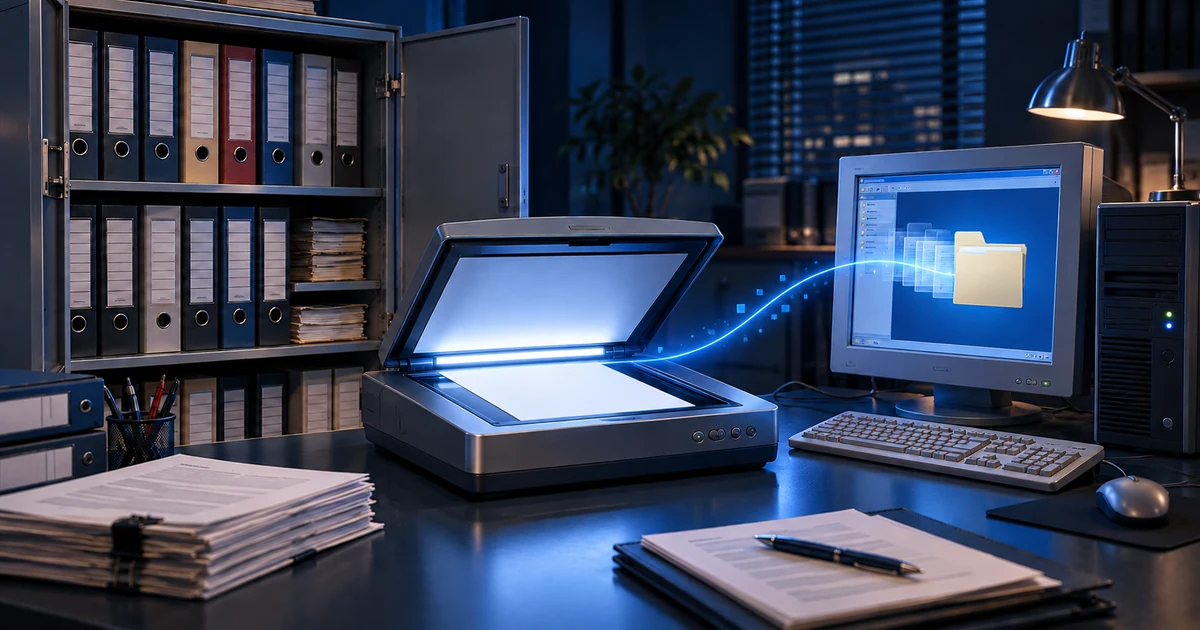
Searching for a contract in a cabinet, copying attachments, and sending the set to a branch take time even when the paper archive is well-organized. For an enterprise planning a transition to EDMS in November 2008, the practical task is to make the necessary documents available to responsible employees and reduce redundant copying. An electronic document management system helps organize the catalog, search, and access control. Mass scanning without document descriptions and quality checks will not produce such a result.
Which Documents to Start With
The first practical step toward optimizing archive management is an inventory of selected document categories. Instead of attempting to immediately digitize the entire array of papers accumulated over past years, it is advisable to focus on the most in-demand categories — active contracts, supplementary agreements, primary financial, and personnel documentation.
During the inventory, the following parameters are evaluated:
- document types and their volumes in paper files;
- frequency of employee access to specific document categories;
- current time spent retrieving a file, making a copy, and courier delivery;
- physical location of materials with recording of box numbers, shelving racks, and responsible persons.
When determining document retention periods, enterprises are obligated to follow the norms of the List of Standard Documents Approved by Order of the Main Archival Administration No. 41 dated July 20, 1998 (as amended on April 26, 2008). This regulatory act establishes minimum retention periods for various categories of managerial and financial documentation. An organization has no right to shorten these periods on its own decision; therefore, at the initial stage, an electronic archive operates in parallel with the paper one.
Scanned Copy and Electronic Original
When transitioning to electronic document management, it is important to clearly distinguish between an electronic original and a scanned copy of a paper document. In accordance with the requirements of the Law of Ukraine "On Electronic Documents and Electronic Document Management" No. 851-IV (as amended on June 24, 2005), only a document that contains all required details and an applied electronic digital signature (EDS) of the author or signatory is considered an electronic original.
Scanning creates a copy of a paper document. Applying an EDS to a copy file does not in itself convert it into an original document and does not permit the destruction of the paper. The selection of documents for destruction requires checking retention periods, conducting an appraisal of value, drawing up acts, and obtaining required approvals according to archival rules. The grounds are defined by the Law on the National Archival Fund and the List under Order No. 41. Therefore, savings on archive space should not be prematurely included in the quick effects of scanning.
Scanning, Description, and Quality Check
To ensure high quality of the electronic archive, the digitization process must be clearly regulated. The technological chain includes material preparation, direct scanning, quality control, and entering the document card into the system.
The digitization procedure consists of the following mandatory steps:
- File preparation: checking the order and integrity of sheets, removing paperclips and staples.
- Scanning: using flatbed or feed scanners depending on the physical condition of the paper and sheet density.
- Quality control: checking completeness, image clarity, correct page orientation, presence of reverse sides with seals, and attachments.
- Description and indexing: entering mandatory registration data (date, outgoing number, counterparty, document type, retention period, exact location of the paper original).
Optical character recognition (OCR) helps search for words inside scanned documents. However, surnames, amounts, and numbers may be recognized with errors. Before using this data in calculations or correspondence, it is reconciled with the image. The recognized text is saved in association with the scan; it does not replace either the paper original or a properly executed copy.
The benefit for the customer lies in faster search for the required set and managed access to it. Paper originals remain in storage until there are legal grounds and a properly executed decision for their removal.
Access to Copies and Accounting of Originals
Organizing an electronic archive involves strict segregation of access rights based on a role model. Access is provided through a single user catalog. Personnel, legal, and accounting department employees receive granularly configured permissions in accordance with their job duties.
In the card, it is necessary to indicate the file status: scanned copy, working draft, or electronic original. For a new edition, a separate version is saved without overwriting the previous document. In the head office, access can be organized via a local network; for branches — via a configured inter-office connection. If an employee takes a paper file, the recipient and return deadline are recorded in the card. This helps locate not only the electronic copy, but also the physical original.
Data Storage and Recovery
Server capacity is calculated taking into account the number of pages, scanning quality, and expected growth. Backups should be stored separately from the main storage. During a test restoration, files, cards, access rights, and relationships between documents are checked. Readability checks of formats and data migration to healthy media are planned separately: a file that is preserved but does not open will not help an employee prepare a response to a request.
Organizations are recommended to consider international methodological approaches to business continuity management, in particular NIST SP 800-34 (2002) manual. The use of this methodology is voluntary and helps develop action procedures in case of emergency situations. Backups do not replace regulatory document retention periods, but serve as a means of technical protection of information. In case of network failures, a temporary paper workflow procedure is provided, followed by data synchronization.
Costs and Pilot Project Evaluation
Budgeting digitization projects requires accounting for the total cost of ownership (TCO). It consists of labor costs (preparation, scanning, description and indexing, quality control), equipment procurement, software, staff training, technical support, and costs of maintaining the paper archive during the mandatory period.
Monetary savings arise in that part of expenses that the enterprise has actually reduced: for example, ordering fewer copies or transmitting them by courier less frequently. For this, it is not necessary to completely cease paper workflow. Freed employee time is a separate benefit: it can be used for other tasks, but it does not mean an automatic reduction in payroll costs.
For an objective assessment of efficiency, it is recommended to start with a pilot project on a limited set of documents. During the pilot, the following metrics are monitored:
- median time to search for the required document;
- share of correctly located complete files;
- percentage of cards with correct indexing on the first try;
- success and speed of test restoration from backup.
Scaling the system to the entire volume of the enterprise is carried out only after the measured results of the pilot project confirm the expediency of further investments.
Questions and answers
Does digitizing paper documents allow for the immediate destruction of their paper originals?
No. Scanning, including subsequently signing a copy file with an EDS, does not grant an automatic right to destroy the paper original. It is necessary to check retention periods, conduct an appraisal of value, and prepare the required acts and approvals.
What mandatory requisites must an electronic document have to be recognized as an original in 2008?
According to Law No. 851-IV, an electronic original must contain all mandatory requisites specified by law and an applied electronic digital signature (EDS).
What metrics should be used to evaluate the success of an EDMS pilot project?
They evaluate the median search time for files, the proportion of fully located sets, the percentage of correctly filled cards on the first attempt, and the speed of successful data recovery from a backup.
Sources
- Law No. 851-IV "On Electronic Documents and Electronic Document Management", version dated June 24, 2005
- List of Standard Documents under Order No. 41 dated July 20, 1998, version dated April 26, 2008
- Law No. 3814-XII "On the National Archival Fund and Archival Institutions", version effective in November 2008
- NIST SP 800-34, Contingency Planning Guide for Information Technology Systems, 2002